Author Archives: MzEllen

3 Comments

In chapter 5 of Nehemiah we read about another of the problems that the Jews were having - with Jews.

Jews were lending Jews money - and charging such an interest rate during a time of famine that the "lendees" were having to sell their children into slavery.

Nehemiah told them: "The thing that you are doing is not good." Nehemiah stood up for those who were being taken advantage of financially.

It seems that it was about this time that Nehemiah was made governor in the land of Judah and the heading for this part of the chapter is "Nehemiah's Generousity". He did not take the food allowance, he did not "lord it over the people" and he acquired no property.

And still, he tells us that he "persevered in the work on this wall"...

So what?

We are not Jews, we are Christians. And we are part of the family of God.

Are there churches (or organizations) that take financial advantage of other Christians?  (I'm thinking of one "word-faith" church that requires members to turn in w-2's" each year so that the church can make sure that they are turning their entire tithe over to this church.)

2 Comments

Most readers here will know that I'm not egalitarian. I believe firmly that God created man and woman - and that He created them with different roles. That does not mean that men and women are not equal - but they are different.

Mark Driscoll is taking a beating on certain blogs for his blog post that was triggered by Ted Haggard's situation, but spoke to men in leadership in general.

In particular, another pastor in Seattle, Rose Madrid-Swetman, has written an "open letter" to Driscoll. Now (this is important) Madrid-Swetman has an agenda. She says so, on February 4, 2005:

Here is my agenda that I won't give up...

I want to see space created in the church for women to lead...

In September, two months before Driscoll wrote his post, Madrid-Swetman wrote:

There is a very big, inflential church in our city that holds a complementarian view. The complementarian view in our humble opinion is oppressive to women. It seems the more influence this church gets the more we are hearing questions as to "why" do they teach oppression of women?

So we know from Madrid-Swetman's writing that

  1. she has an agenda that she won't give up
  2. she was convinced before Driscoll wrote his post that "this church" holds a position that is oppresive to women.

Given those two things, it is my opinion that her "open letter" is a shot across the bow at Driscoll's theology concerning gender roles, not simply a response to his tone and to that particular post. This is a woman with an agenda (go back to the beginning of her blog).

But what about Mark Driscoll? I like Mark Driscoll and his general theology (I disagree with his - and his church's stand on divorce) and I especially like his stand on gender roles.

The only thing that I can see that would be offensive in general is the remark about it not being uncommon to see a pastor's wife who has "let herself go". Beyond that, it is the gender role theology that is offensive to those who embrace the opposite view. A woman who resents being taught that she is partly responsible for the purity of her husband - and that she is responsible for filling his sexual needs and desires - will find offense in the entire paragraph or two that addresses sexuality between a husband and wife.

What I do find fault with is Driscoll's appearing to emphasize the physical side of attractiveness. I seem to remember (and somebody can probably find it for me) where Driscoll said in one of his podcasts something to the effect that he wanted his wife to get rid of some of her clothes and revamp her wardrobe because she "looked too much like a mom". They have how many kids?!?! If you want to preach having a lot of kids, you need to be prepared for women who look like moms.

But as far as gender roles in home and church...I have NO beef with Driscoll.

Cain and Abel?

I was challenged to ponder this - and I don't know yet if I'm headed in the same direction as my challenger...but this is the direction that I went:

You all remember Cain and Abel.  Before this point in the Bible, God does not tell us how He wants sacrifices to be carried out, but Cain and Abel sacrificed to God.  We don't know whether or not God had told Adam and Eve, or Cain and Abel, what sort of sacrifice He wanted.  We are not even told until after this story that "men began to call upon the name of the Lord."
We do not know whether or not Cain knew that his sacrifice of the field would not be acceptable.  But it was not acceptable, while Abel's sacrifice of meat and fat was acceptable.

What we do know is how Cain reacted.

I'm not sure that I have the words to articulate this, so this truly is a "type while I think" sort of post...

We have no indication that Cain believed did not think his sacrifice would be acceptable.  The Bible does not tell us that Cain was acting in defiance of God when he sacrificed from the field.  It is very possible that Cain truly believed that he was doing the right thing.  Abel was a keeper of the flock and sacrificed from the flock; Cain was a keeper of the field and sacrificed from the field.  Both men sacrificed from the work of their own labor.

Let's assume that Cain held the conviction that sacrificing from the fruit of his own labor was God's will.  It is the same with those who embrace the egalitarian gender role (or lack thereof) theology.  For most, I have no reason to believe that they are insincere in their belief - they truly believe that there are no gender roles.

But Cain was wrong. What reaction did Cain have to God's rejection of his sacrifice?  He killed his brother.

Remember - as far as we know, Abel had nothing against his brother - it was the sacrifice Abel did not reject Cain or his sacrifice, it was God who rejected Cain.

The connection that I am making is that (even believing that he was doing the right thing), Cain was wrong.  And (being wrong) he lashed out.

Cain lashed out, but not at God.

Most Christians in this century don't kill those they lash out toward, but certainly "character assassination" is not unheard of.

Misogyny, abusive, oppressive are just a few of the labels that Driscoll has "earned" for his strong (and I believe Biblical) stand on gender roles.  Feminists (Christian and unbelievers alike) lash out at him.

That Driscoll and Mars Hill have come to their beliefs through sincere study of the Word seems to make no difference...


3 Comments

I'm going to cover chapters 3 and 4...I had another post started, but I'm really enjoying Nehemiah.

In chapter three, we mostly have a list of who did what - mostly names I cannot pronounce (ask a dear friend about my language challenge).

At any rate, we find that there are priests and temple servants and goldsmiths and perfumers who were all working on the wall.

One thing I noticed:

the Tekoites repaired, but their nobles would not stoop to serve their Lord.

Everybody pitched in, but there were a few who were "too good" to serve their Lord.

In chapter 4, we see Sanballat is up to no good again:

"...he was angry and greatly enraged, and he jeered at the Jews. And he said in the presence of his brothers and of the army of Samaria, "What are these feeble Jews doing? Will they restore it for themselves? Will they sacrifice? Will they finish up in a day? Will they revive the stones out of the heaps of rubbish, and burned ones at that?" Tobiah the Ammonite was beside him, and he said, "Yes, what they are building--if a fox goes up on it he will break down their stone wall!"

We see that this man didn't like what Nehemiah was doing. He chatted amongst those who agreed with him, mocked and baited. But Nehemiah didn't take the bait.

He prayed and gave it to God:

Hear, O our God, for we are despised. Turn back their taunt on their own heads and give them up to be plundered in a land where they are captives. Do not cover their guilt, and let not their sin be blotted out from your sight, for they have provoked you to anger in the presence of the builders.

And then Nehemiah went about the Lord's work:

So we built the wall.

So what did Sanballat & friends do?

...they were very angry. And they all plotted together to come and fight against Jerusalem and to cause confusion in it.

Still, Nehemiah prayed, but this time he also took practical steps and set guards. How dedicated was Nehemiah and those who labored along side of him?

So we labored at the work, and half of them held the spears from the break of dawn until the stars came out. I also said to the people at that time, "Let every man and his servant pass the night within Jerusalem, that they may be a guard for us by night and may labor by day." So neither I nor my brothers nor my servants nor the men of the guard who followed me, none of us took off our clothes; each kept his weapon at his right hand.

What about us?

When we run up against those who oppose us, how do we handle it?

Do we cave and run?  Or do we pray, take precautions and dig in to our work?

3 Comments

The first chapter of Nehemiah ended with a single sentence:

Now I was cupbearer to the king.

In the second chapter we learn that the king must have liked Nehemah pretty well. The prophet states that he had not been said in the king's presence, yet the king knew that there was something wrong. And he cared enough to ask about it - and Nehemiah unloaded:

"Let the king live forever! Why should not my face be sad, when the city, the place of my fathers' graves, lies in ruins, and its gates have been destroyed by fire?"

The king asked (Ellen's paraphrase), "so, what do you want me to do about it?" Nehemiah took time to pray and then asked the king to allow him to go rebuild Jerusalem.

Not only did the king let him go to rebuild Jerusalem, he sent him with letters that would let him pass through the lands safely, would let him get timber, and to build a house for Nehemiah to stay in, and sent him with officers of the army and horses! Why? Nehemiah tells us it was because, "the good hand of my God was upon me [Nehemiah]."

In the second part of the chapter, we find Nehemiah's enemies:

But when Sanballat the Horonite and Tobiah, the Ammonite servant, heard this, it displeased them greatly that someone had come to seek the welfare of the people of Israel.

Nehemiah went along on his way and inspected the walls, which were in a shambles. He made plans and gave a "pep talk".

Then I said to them, "You see the trouble we are in, how Jerusalem lies in ruins with its gates burned. Come, let us build the wall of Jerusalem, that we may no longer suffer derision." And I told them of the hand of my God that had been upon me for good, and also of the words that the king had spoken to me.

And the people were with him...

But not all...

But when Sanballat the Horonite and Tobiah, the Ammonite servant, heard this, it displeased them greatly that someone had come to seek the welfare of the people of Israel.

As Nehemiah's story continues, these guys show up again and again.

First, they make fun of him and his mission:

But when Sanballat the Horonite and Tobiah the Ammonite servant and Geshem the Arab heard of it, they jeered at us and despised us and said, "What is this thing that you are doing? Are you rebelling against the king?

But Nehemiah continued in the Lord's work.

How does this apply us today?

Do you have a "mission"?  Something that the Lord has laid upon you?

Is there somebody who might jeer at you?

Is there any way that you feel like a "Nehemiah" today?

7 Comments

I said yesterday that the book of Nehemiah was written in first person; it's a book of determination and plotting, of steadfastness to God and intrigue. Because it's written in first person, I got into the first chapter and was reading it as a book read for "recreation".

Nehemiah is Scripture, and as with all Scripture, it is breathed out by God and profitable for teaching, for reproof, for correction, and for training in righteousness, that the man of God may be competent, equipped for every good work.

In chapter one we meet Nehemiah. He was in Susa, which still exists today in modern-day Iran. He would have come to Susa when the Jews were exiled, but he still had at least one brother in Jerusalem. "Certain men" came to Nehemiah from Jerusalem and Nehemiah asked them for a report.

"The remnant there in the province who had survived the exile is in great trouble and shame. The wall of Jerusalem is broken down, and its gates are destroyed by fire."

Nehemiah wept - for days. He wept, and fasted and prayed...and repented. And He asked God for mercy.

"O Lord, let your ear be attentive to the prayer of your servant, and to the prayer of your servants who delight to fear your name, and give success to your servant today, and grant him mercy in the sight of this man."

Who was Nehemiah? He was the son of Hacaliah, brother of Hanani. He worked in the palace and was apparently on good terms with the king.

The first chapter concludes with a single line:

Now I was cupbearer to the king.

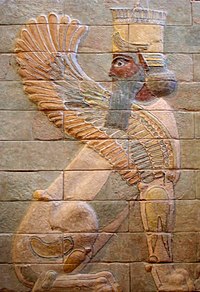
Winged sphinx from the palace of Darius the Great at Susa.

what does this mean to us?

Parts of Christianity are broken down.  Do we weep for the brokeness of Christianity?  Or do we seek to hide our heads in the sand with the make-believe story that things are "ok"?

In a time when false doctrine and false teachings abound, do we weep and seek to restore things to Biblical order?

How broken are we, for the brokeness of the body of Christ?

4 Comments

My lead teacher - Ann's mom was recently diagnosed with cancer and passed away Wednesday afternoon. Ann's aunt passed away yesterday. Even a strong Christian family is left reeling with a 1-2 punch like that. Saturday is the funeral, and it is also Ann's birthday. The family needs prayer.

Ann's parents are Christians and her dad requested that memorials be given to their denomination. This is becoming more common and (after a comment by coworker) I have a question.

If the denomination in question is not your own, do you (or would you) not to donate money in the name of a person who loved that denomination?

When my husband passed away, I did ask for donations to my church's youth group, for a specific project. While I didn't have this situation in mind (the not wanting to donate because of denominational differences), and while I realize that nobody would have told me that they were offended by the request, I do wonder, in hindsight, if that was the case.

Obviously, if it's a religion that is not Christian, it becomes a different question.

2 Comments

I'm in a women's Bible study and we're going through "Speaking Wisely" by Poppy Smith.  This week's topic was "gossip".  There was a lot of good material, but I think that "gossip" was not the point of the text.

The book of Nehemiah was written in first person - not usual for the Bible.  It's not a very long book, I'd encourage you all to sit down and read it from start to finish.  It was very encouraging at a time when I needed it.

It's not so much about gossip - although those who hated what Nehemiah was doing did use false reports to fight his work.  It's more about standing firm.

A lot of things were brought to mind and I'm going to be posting on it over a few days - right now - it's been a long day and I think I'm going to chill...

6 Comments

I want to be very clear that this post - in the end - is not about Ted Haggard. That subject has been booted around a lot. Some have sugggested methods and steps (protections) that should have been present in his life. Others have written that none of us should be surprised because any of us could be Haggard. Whatever his church and oversight folks do, I'd like to see it permeated with grace and mercy, with an eye toward repentence, followed by full restoration.

How could we have prevented this is the question that many people are trying to answer. Among Pentecostals, perhaps a better question is, more honestly, “why didn’t you see it” – for all of these apostles and prophets that claim to hear directly from God - this is a question that I have not seen addressed.

What I have yet to see explored has been the silence (pre-scandal) of those who partnered with Haggard. This is not "guilt by association" - this is partnership.

This entire “Haggard tragedy” says as much about the Apostolic movement than it does about Ted Haggard.

A while ago I wrote a post called "Today's Prophets". I noted back in January that today's "prophets" seemed to specialize in telling people that which they want to hear...that everything is going to be good, that we’re going to lose weight, that we’re not going to be alone.

We don't hear from the "Nathans" - who looked at David and told him "YOU are the man."

I said, "It brings doubts to my mind when we only embrace the “prophet” that tells us the pretty things."

The question that I'll ask at the end of this post is, "why didn't they see?"

~~~~~~~~~~~~

There is a "prophet": Haggard did not operate in a vacuum. Does the name C. Peter Wagner sound familiar? It should; Peter Wagner is the president of Global Harvest Ministries, which designed especially, but not exclusively, to meet the needs of leaders who have become a part of the New Apostolic Reformation.

Here are some of Wagner's words concerning "prophets".

As noted in these Scriptures [here is the article], prophets play a key role in the life of the local church. They are responsible to declare the word of the Lord. Their declarations bring direction and clarity of the purpose of establishing the body of Christ...

It is imperative that the authenticity of a given prophetic ministry be tested at its very outset in a local church...

A keen ear is necessary to discern the spiritual climate in a church and the issues currently being faced. Prayer and fasting causes prophets to be perceptive to the direction in which God would have the church to proceed. How can prophets declare a "word," unless they have heard a "word" from God?

His[Jesus'] consistent ability to discern a matter and then accurately address it was based upon His intimate relationship with the Father

There is a partnership: What does C. Peter Wagner have to do with Ted Haggard?

A lot.

Let's focus on the "World Prayer Center".  This is a public relationship that is documented by the Wagner.  On the World Prayer Center website, it says:

The World Prayer Center was birthed in a vision given to Pastor Ted Haggard on Pikes Peak while praying and fasting in 1984 [...]

In the 1990's C. Peter Wagner coordinated the launch of AD2000- the largest prayer movement in the history of the church- that linked over 40 million intercessors from 120 nations in united prayer. During that time, the Wagners relocated to Colorado Springs joining the vision and mission to build the World Prayer Center.

On Wagner's website:

Global Harvest Ministries was born in 1991. Doris and Peter Wagner were the parents and Luis Bush was the midwife. Those were the early days of the AD2000 Movement [...]

Through AD2000 we met Ted Haggard, pastor of New Life Church, and Ted challenged us to move our Global Harvest offices from California to Colorado Springs (where Luis Bush also had his AD2000 office), and partner with him in establishing the World Prayer Center.

This is NOT "guilt by association" -  this is an outright parnership.  Haggard and Wagner are not in mere association with each other, they are partners in ministry, on the same campus.  Haggard invited Wagner to come to Colorado Springs, with the express intent of partnership.

So, what's the issue?

As I said in January, we have self-proclaimed "prophets" running around, telling people only what they want to hear.  With these "apostles" and "prophets" in partnership with Ted Haggard - why didn't they see?

A prophet should be able to discern a matter and then accurately address it.  If these prophets are real, if they are able to hear a word from God and speak truth into a person's life...

Why didn't they see?