Subscribe to MzEllen – For the Life of Me Subscribe to MzEllen – For the Life of Me's comments

Archive for the ‘Crafting’ category

The plan is to complete a project – start to finish.

Starting with the animal.

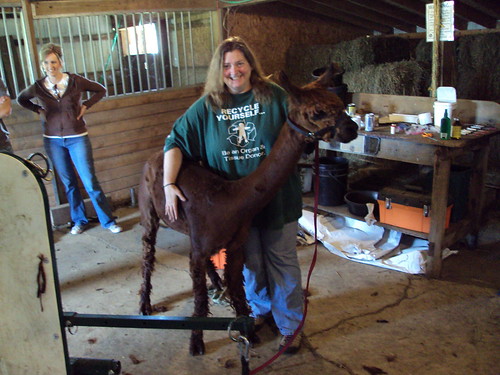
Shearing day was yesterday.  I started out with meeting the alpaca a couple of months ago.  His name is “Raffle Tickets” and he’s two years old.  He’s also never been sheared so he has a lot of baby hair left and some of the fleece is about a foot long.
SDC13911 The “VM” (vegetable matter) that sticks to him is because of the baby hair that is much finer than the adult hair.

I was able to spend a few minutes combing him before shearing to remove a lot of it – there’s still a lot to go!

I don’t have a good “pre” photo, but here’s what I have:DSC00240.

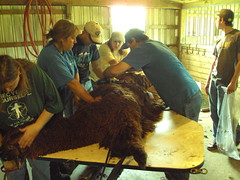
Here’s the process:  The shearer has a table that tilts both ways.  Starting with the table top “up and down”, lead the animal to the table with his (or her – but I’ll use “his” because Raffle Tickets is a male)  body parallel to the table top.  There’s a wide belt that goes around his belly and 4 straps that attach to his feet.  Mostly we could get two of the foot straps on while the animal was on the ground.  You flip the table so it’s flat and get the other foot straps on, stretching the beast’s legs to either end of the table.   They leave the halter on and as long as the animal’s head is immobilized, they don’t fight and mostly lay very still.  If they think they can move their head, they try to get up.  I was the “head holder” for about 8 shearings.

Once the animal is on the table, the shearer goes to work (the whole table thing sounds like torture, but I’ve seen sheep being sheared that are not immobilized and it seems much worse because they fight and get nicked with the clippers – they are more likely to get hurt.)

The ranch where I was sorts the fleece into 3 bags (Firsts, seconds, and trash) – based on the consistency of the fleece.  The “first” clipping is from the back and sides – if the animal is a “good” animal, up the neck and sometimes the back legs).  The “second” is the legs and belly.  The “trash” is the shorter stuff from the rest of the neck, legs, etc – whatever didn’t get caught in the first two runs).  EVEN THE TRASH IS GOOD.   Our last trip to the ranch, several bags of trash was donated to our classroom – we’re using it to learn to spin and we’re doing a lot of needle felting with it.  But it’s not consistent enough to market.

DSC00241I was a good “head holder”.

In order to shear the neck and head, you have to take their harness off and hold them by their ears and pick up their heads (it’s important to hold their ears up and out of the way so they don’t get nicked with the clippers)  Then you “throw the head” to a person on the other side of the table; as the head comes up, so does the body and you just sort of flip them over…it’s a lot smoother than it sounds.

As the shearer gets the other side of the animal, the “head holder” puts the harness back on.

As all of this is going on, the animal also has his “top knot” clipped with scissors, gets any shots from the vet and gets his teeth and hooves checked (and trimmed if needed).

When all this is done, his feet are let loose and the belt is loosely wrapped around him again (just for steering now) and the table is tilted in the other direction.  He gently slides off the table and lands on his feet – all done!
DSC00251

I’ve started a blogger blog for this project…it’s going to be quite a deal! I got 8.4 pounds of fleece so now I start the process of washing, cleaning (VM), combing, carding, spinning and knitting (or weaving)

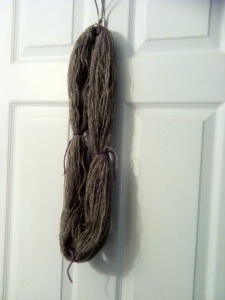
I was able to get my hands on a small bag of baby alpaca fleece (see the beige fiber below).  I was told that it is easier to spin unwashed alpaca because the dust helps hold it together – which may be true…but!

allergies…to dust.

I’m pretty miserable today, so I’m in the process of washing just enough fiber to spin in a week (otherwise I will have accidental felting)

Unruly Llamas

Part of an order I places is being delayed by “unruly llamas”.

My alpaca fiber is back-ordered

;-)

The baby camel top (sample size only) is on the way.

Sock of the Week – check.  Next week’s “official” sock is nearly done (you’ll see it next week)

On the spining front…

I bought a bag of alpaca fiber – the animal’s name is “Juan” and the color pathway is called “blue sheen”.

Here’s Henry spending quality time with Juan’s long, silky hair…

.

alpaca (Juan) on drop spindle.(the fiber spun onto a drop spindle – it’s counter intuitive, but the lighter the spindle, the finer the thread; I think because it spins faster.
Juan's wool in ballThis is how fine it’s spinning up.  This is a single ply thread – when all the fiber is spun, two balls will be spun together with the spindle going in the opposite direction of the single ply – this is called “worsting”, making worsted yard.
SDC13756

My first experience with spinning was with sheep’s wool
after worsting and washing
SDC13778
Close up
sheep wool in hank closeup
wound into a ball
sheep wool in ball
and being knit into a scarf with a cable twist
spun sheep wool being knit into scarf

As I am working on socks, these will fill the “shoes with toes” requirement for work, but still let me show off pretty socks.

The Sock

I’m currently knitting my first ever sock.  I’ve knitted a lot, but never socks or mittens (double pointed needles).  My newest most favorite yarn shop showed me a new method that really works…but…

I started the thing many times (Tom doesn’t know how many times.)  I ripped it apart, wound the yarn back up and started again.

Each time I used the same pattern, the same needles, the same yarn.   I kept doing it and doing it and doing it and each time I discovered a little something that was giving me trouble.

Eventually, it clicked.  And I think I’m going to find socks quite rewarding.

It struck me that my walk with God is something like that.  I have the right tools.  He has given me what I need and He will continue to do so.

Each time I get a little further.  Each time I discover something I didn’t “get” before. But each time I end up unraveling and beginning anew.

Each and every day, I end up with a greater understanding of my own sin, my failure, my need for a Saviour.

Each and every day, He provides what I need.

The steadfast love of the LORD never ceases;
his mercies never come to an end;
they are new every morning;
great is your faithfulness.
“The LORD is my portion,” says my soul,
“therefore I will hope in him.” (Lam 3:22-24)

Okay…I made two pieces of knitting – one in garter stitch, the other in stockinette.  I took before and after photos…

This first piece started out (cast on 30, knit for 20 rows) 11 inches by 4 inches and ended up stretched width-wise, but only 3 inches tall.

This second piece (stockinette, cast on 20, work for 20 rows) started out 6 inches wide and 6 inches tall.  It ended up 7 inches wide and only 4 inches tall.

Lessons learned:

  • bind off very (VERY) loosely – in fact, try knitting the last row and binding off with a huge pair of needles.
  • get to the washed piece quickly in order to block it while it’s wet (although this may not be as important if you bind off loosely)
  • stockinette and garter stitches don’t act the same.

SDC13194I was in Indiana Tuesday with my sister-in-law Judy. We went on a “quilt tour” in Amish country and saw this mural and this (below) garden

SDC13177 (the quilt pattern of the garden is “Lone Star”.

For more information on the tour, visit this site.