Author Archives: MzEllen

35 Comments

A wife is compared to the bride of Christ - the church. A wife is instructed in Ephesians 5 to submit to her husband as the church submits to Christ. In that same parallel, the husband is to model the love for his wife after the love that Christ has for His bride, the church. We have a wonderful privilege and responsibility to reflect that to the world.

Our Christian marriages should point people straight to Christ! If people don't look at our marriages and see them reflect Christ and the church, we are failing.

If the world looks at our marriages and sees anything less than a sacrificial love, we are failing. If the world looks at our marriages and sees a husband putting himself before the needs of his wife, we are failing. If the world looks at our marriages and sees the wife with anything less than the willing and loving submission that the church has for Christ, we are failing.

And...we are failing.

That is why the gender debate matters. The statistics say that Christian marriages are as likely to fail as secular marriages (I have my doubts about the questions asked and think that more should have been asked that would "unskew" the numbers)...but the numbers are not good.

Why is the divorce rate so high? Just like in Jesus' time...hardness of hearts. On the part of both parties.

If the love/submission is modeled on Christ and the church...if the love is modeled after Christ and the submission is modeled after the church - it is the model of Scripture. Each puts the other first, in a way that reflects Christ and the church.

We are the shadow; the mirror. How do we reflect Christ to the world?

2 Comments

(Or...let's play "which of these items doesn't belong?")

I was cruising around Amazon.com...checking out the radioactive uranium samples.(Thank you Tom McMahon)
What is weird (other than Amazon carrying radioactive uranium ore) is the part that says,

"Customers Who Viewed This Item Also Viewed..."

First off: we have a land cruiser for only $19,999.95

...continue reading

1 Comment

From GetReligion:

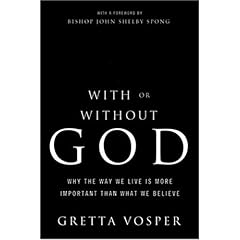
"God does not answer our prayers. Jesus is not the saviour who saved the world by dying for our sins. Simply put, Christianity is “love one another.” Gretta Vosper, founder of the Canadian Centre for Progressive Christianity and a minister in Toronto, believes that the church, as we have built it and known it, has outlived its viability." (Amazon.ca)



Mollie (GetReligion) notes:

Lewis provides many details of what Christianity without Christ looks like. Vosper does not believe in the Virgin Birth, the Resurrection, the miracles and the sacrament of baptism. Nor does she believe in the creeds, the presence of Christ in communion or that Jesus was the Son of God. There’s more:

In With or Without God, her book that was formally launched this week, she writes that Jesus was a “Middle Eastern peasant with a few charismatic gifts and a great posthumous marketing team.”

The Bible is used in her services, but it gets rewritten to be more contemporary and speak to more people. Even the Lord’s Prayer — also known as the Our Father — does not make the cut because it creates an image of a God who intervenes in human existence. And then there is the “Father” part that is not inclusive language and carries with it the notion of an overbearing tyrant who condemns people to hell.

Again, I am reminded of the words of Reinhold Niebuhr when he described the creed of liberals : "A God without wrath brought man without sin into a kingdom without judgment through the ministrations of a Christ without a cross."

And yet...this is the goal

The feminist movement in Western culture is engaged in the slow execution of Christ and Yahweh. Yet very few of the women and men now working for sexual equality within Christianity and Judaism realize the extent of their heresy. It is likely that as we watch Christ and Yahweh tumble to the ground, we will completely outgrow the need for an external God. We, women are going to bring an end to God. We will change the world so much that He won’t fit in anymore.”- Naomi Goldenberg (feminist) - emphasis mine.

"Organization" of the week:

The Elisha Foundation.

The Elisha Foundation was founded to provide refreshment and encouragement to families caring for people with special needs. Through programs such as family retreats, we seek to provide access to resource professionals, educational specialists and other valuable resources while spending refreshing quality time as a family.

We recognize the need to encourage families who are caring for these special people. Our family retreats provide a balanced schedule of workshops and activities for the family, as well as for each individual, while providing a refreshing and fun environment for the entire family.

~~~~~~~~~~

~~~~~~~~~~

J.I. Packer leaves the Anglican Church.

Some say that the homosexual issue is the breaking point, but the problem is liberalism

Packer urged Anglicans who are adamantly opposed to liberal developments in the Anglican church in Canada and the U.S. to remain "tough" as they re-align themselves under Archbishop Venables into a new non-geographically-based form of Anglicanism.

HT: Denny Burk

~~~~~~~~~~

~~~~~~~~~~

John Piper on TULIP (mp3's)

Nine sessions and notes.

HT: Between Two Worlds

~~~~~~~~~~

~~~~~~~~~~

Morbid, yet...interesting...

chocolate skulls. Made from a cast of a real human skull.

~~~~~~~~~~

~~~~~~~~~~

And another photo from one of my favorite photo sites: Dark Roasted Blend.

okay...just one more.

5 Comments

From Toward An Egalitarian Ecclesia at Theology for the Masses (writing of 1 Timothy 2:12):

Interestingly enough, the history of translations of this passage is that the dominant translation of this word before WWII had to do with the violent treatment of men in the congregation – ‘usurping authority’ in the KJV is among the least obvious of these and even it has remnants of the idea.

The notion that "authority" was not seen in the the passage until WWII is wrong - especially reading the study notes and commentaries.

There weren't all that many translations:

...continue reading

7 Comments

A comment by minnowspeaks (an egalitarian):

"Then as now my greatest difficulty is with the notion that a loving Creator would purposely gift His creation in a certain way only to insist His creation NOT use the gifts. Such a notion goes against my belief in a loving God as well as the idea that our gifts are meant for the edification of the whole."

1) Complementarians do not deny that all members of the bride of Christ are gifted OR that they should be able to use their gifts within Scriptural limits.

2) Why is it that if a woman cannot use her gifts to teach or lead men, you do not consider her to be using her gifts?

possibilities:

...continue reading

29 Comments

No...that's not my question, but rather the question on ""Parchment and Pen."

"Why is it okay to think that men know so much, have so much insight, are so sensitive to all the nuances of a particular Bible passage that they can teach women in a way that women are able to learn and understand week after week but the insights and sensitivities of women are so inferior that men could/should never learn from them? Or how is this not what is being said?"

Since this is not what is being taught by most complementarians, it might be useful to note that complementarians are not monolithic (just as egalitarians are not).

It might also be useful to note that most complementarians do not teach that women are not insightful, that women are not sensitive to Scripture or that women are inferior.
Most complementarians do not teach that "men could/should never learn from them?"

From "The Council for Biblical Manhood and Womanhood:"

"Listen to how John Piper and Wayne Grudem summarized this answer to this question. "When Paul says in I Timothy 2:12, ‘I do not permit a woman to teach or to have authority over a man; she must be silent,' we do not understand him to mean an absolute prohibition of all teaching by women. Paul instructs the older women to teach what is good, then they can train the younger women. And he commends the teaching that Eunice and Lois gave to her son and grandson. Proverbs praises the ideal wife because she speaks with wisdom and faithful instruction on her tongue. Paul endorses women prophesying in a church and says that men learn by such prophesying. And that members should teach and admonish one another with all wisdom as you sing songs, hymns, and spiritual songs. And then, of course, there is Priscilla at Aquilla's side correcting Apollos. It is arbitrary to think that Paul has in mind every form of teaching in I Timothy 2:12. Teaching and learning are in such broad terms that it is impossible that women not teach men and men not learn from women in some sense. There is a way that nature teaches and a fig tree teaches and suffering teaches and human behavior teaches. If Paul did not have every conceivable form of teaching and learning in mind, what did he mean? Along with the fact that the setting here is the church assembled for prayer and teaching, the best clue is by coupling teaching with having authority over men. We would say that the teaching inappropriate for a woman is the teaching of men in settings or ways that dishonor the calling of men to bear the primary responsibility for teaching in leadership. This primary responsibility is to be carried by the pastors or elders. Therefore, we think it is God's will that only men bear the responsibility for that office."

Also from CBMW:

Also, I see no need to go be­yond Scripture, which does not prohibit (permits but does not mandate) prayer or testimony by a woman in the con­gregation nor forbid her interaction on biblical truths in a private conversation with a man (as Pricilla and Aquila with Apollos in Acts 18:26).

From another article by Wayne Grudem on CBMW:

Now regarding the question of women in the church, what actions should we put on this scale? On the left side of the scale we can put verses such as 1 Timothy 2:12, where Paul prohibits a woman from teaching or having authority over men. Since I think it is very evident from the context that Paul is talking about the assembled congregation in this passage (see 1 Tim. 2:8-10; 3:15), and he is giving principles that apply to the entire congregation (see 1 Tim. 3:1-16), I think that the left end of the scale prohibits women from teaching or having governing authority over the whole congregation.

What shall we put on the right end of the scale? Here we would put verses such as Acts 18:26, where, in a less formal setting apart from an assembled congregation, we find that Priscilla and Aquila were talking to Apollos, and "they took him and expounded to him the way of God more accurately." This situation is similar to a small group Bible study in which both men and women are participating and in that way "teaching" one another. Another verse that we can put on the right end of the scale is Titus 2:4 which tells the older women to "train the younger women to love their husbands and children..."

We see from these writings that an across the board prohibition of women teaching men is not what is being taught. Rather it is the teaching that complementarians believe that Paul is teaching that women should not teach the congregation at large, or have authority in that context.

3 Comments

What is the difference between a "ruler" and a "leader"?

Short and simple (and leaving a lot of blanks)

  • A ruler can lead from anywhere. Front, back, middle. As a participant or not. "do this and I'll have coffee" is an option. A ruler is more forceful (sometimes of necessity, sometimes out of character)
  • A leader gathers information (this is not ruled out with a "ruler") makes a decision based on the input of others (also not ruled out with a "ruler") and states a goal. The attitude is "Let us ALL go in this direction - I'll be the first to step out."

A leader is (by definition) a participant in the achieving of the goal. A ruler may or may not be.

What is the difference between "having authority" and "taking authority"?

There is a line from "Braveheart" the movie. William Wallace says,

"he is not my king." The interrogator tells him (not a direct quote), "oh...he IS your king. Whether you accept it or not makes no difference, he IS your king."

"Having authority" means that...well...the authority is inherent in your position, regardless of whether or not those you have authority over accept it or not. The authority is sometimes God-given, sometimes government-given, sometimes "other"-given (organizations, etc.) The proper attitude toward a person who "haves authority" is an attitude of submission.
"Taking authority" (to me) means that submission is not freely given, it must be taken. Sometimes this is because it is an illegitimate authority, or that a legitimate authority is being abused. Sometimes it is because the legitimate authority is being ignored.

Whether or not the king in Braveheart "had" a legitimate authority, he "took" authority over William Wallace because of Wallace's refusal to submit.

So we see that one does not exclude the other (the king with a legitimate authority "took" authority over Wallace".

On a board of directors there is a legitimate authority in the elected chair. The chair has the authority to lead the meeting in an ordered manner. When a person present attempts to hijack the meeting, the chair also has the right (and responsibility) to "take authority" and get the meeting back on track.

The person who is the "hijacker" is "taking authority" (or attempting to), but they do not "have" authority from a legitimate source. Regardless of the attempt (even if successful) people are free to follow (or not) the source of an illegitimate "taken" authority.

Bottom line?

In my ideal world, leaders would be more plentiful than rulers.

In my ideal world, "taking authority" would not be needed. If those under a person who "has" legitimate authority willingly submitted to that authority, there would be no need for the "taking" of it.